
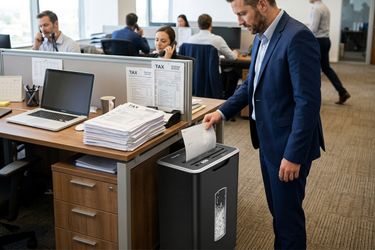
How Long Should You Keep Tax Records Before Shredding Them?
Tax season comes and goes, but the paperwork often sticks around much longer than most people expect. Old tax returns, receipts, bank statements, and supporting documents can quickly pile up in a home office drawer or filing cabinet. At some point, you may wonder whether it's finally safe to get rid of them—or if throwing them away could cause problems later.
The truth is, not every document needs to be kept forever. Knowing what to save, what to discard, and how to dispose of sensitive paperwork safely can help you reduce clutter while protecting your personal information. That's where secure document shredders become an essential part of every home office. So, how long should you really keep your tax records before shredding them?
Standard Guidelines for Document Retention
There isn't a single rule that applies to every financial document. The right retention period depends on the type of record and whether it may be needed for tax verification, warranty claims, or other legal purposes.
The IRS generally recommends keeping tax records for at least three years after filing your return. However, some situations require longer retention periods. For example, if you underreport your income significantly or claim a loss from worthless securities, you may need to keep supporting documents for six or even seven years.
The table below provides a general guideline for common household documents.
| Document Type | Recommended Retention Period | Notes |
|---|---|---|
| Filed tax returns | At least 3 years | Keep longer if your tax situation is complex. |
| Tax supporting documents (receipts, invoices, deductions) | 3–7 years | Retain records that support deductions or credits claimed. |
| W-2s and 1099s | At least 3 years | Keep with the corresponding tax return. |
| Bank statements | 1–3 years | Keep longer if they support tax deductions or major purchases. |
| Credit card statements | Up to 1 year | Retain tax-related statements with your tax records. |
| Utility bills | Up to 1 year | Usually safe to discard after payment unless needed for proof of residency. |
| Investment records | Until assets are sold, then at least 3 years | Important for calculating capital gains or losses. |
| Property improvement records | Keep until the property is sold, then at least 3 years | Helps establish your property's cost basis for tax purposes. |
While digital copies are becoming more common, many households still receive important documents on paper. Once these papers have reached the end of their retention period, they shouldn't simply be tossed into the trash.
Tax returns, Social Security numbers, bank account information, and other financial details can easily become targets for identity theft. Using secure document shredders ensures that sensitive information is destroyed beyond recovery before disposal.
Many homeowners choose compact secure paper shredders designed specifically for personal use because they offer the right balance of security, quiet performance, and convenience without taking up much space.
Why document retention matters
Keeping paperwork longer than necessary creates more than just clutter. It also increases the amount of personal information sitting in your home.
Old financial records may contain:
- Social Security numbers
- Home addresses
- Employer information
- Income details
- Bank account numbers
- Investment information Insurance policy numbers
If these documents fall into the wrong hands, they can be used for identity theft or financial fraud. A reliable secure document shredder allows you to safely eliminate outdated paperwork while maintaining your privacy.
For households that regularly manage taxes, insurance documents, or investment records, secure paper shredders are one of the simplest ways to strengthen everyday document security.
What Documents Can Be Shredded Immediately?
Not every paper deserves a place in your filing cabinet. Once you've confirmed that a document is no longer needed for taxes, legal matters, or warranty purposes, it's usually safe to destroy it.
Common examples include:
- Expired utility bills
- Paid credit card statements
- Outdated insurance offers
- Junk mail containing personal information
- Old paycheck stubs after annual reconciliation
- Duplicate financial records
- Shipping labels with your address
- Pre-approved credit card offers
These documents may seem harmless, but they often contain enough personal information for someone to misuse.
Instead of throwing them directly into the recycling bin, use secure document shredders to completely destroy sensitive data before disposal.
For homeowners who receive a steady stream of financial paperwork, cross-cut or micro-cut secure paper shredders provide a much higher level of protection than simple strip-cut models. Smaller paper particles make reconstruction significantly more difficult, helping reduce the risk of identity theft.
Some documents, however, should never be shredded immediately.
Keep these records until their retention period has passed:
- Tax returns
- Property purchase records
- Home improvement receipts
- Investment transaction documents
- Retirement account statements
- Business expense documentation
- Estate planning documents
When in doubt, it's usually better to keep a document a little longer than to dispose of it too early.
Another practical habit is to schedule document cleanouts once or twice a year—many families choose the period right after tax season. Reviewing old files annually makes it much easier to stay organized without letting paperwork accumulate over time.
As you sort through stacks of outdated documents, you'll likely notice that large shredding sessions place more demands on your machine than occasional daily use. Choosing dependable secure paper shredders with anti-jam technology and continuous runtime helps the process stay smooth, even when you're clearing years of stored paperwork.
Beyond performance, noise also matters in a home environment. Many people work remotely or share living spaces with family members, making quiet operation an important consideration. Modern secure document shredders designed for home offices combine compact sizing with low-noise motors, allowing you to shred sensitive documents without disrupting your household.
Secure Document Shredders for Tax Season
Once you've sorted your paperwork and identified what can be safely discarded, the next step is making sure those documents are destroyed properly. Financial records often contain names, addresses, account numbers, tax identification numbers, and other personal details that shouldn't end up in the recycling bin intact.
That's why many homeowners invest in secure document shredders instead of relying on scissors or simply tearing paper by hand. A quality shredder doesn't just make cleanup easier—it provides peace of mind that your confidential information can't be reconstructed.
What to Look for in a Home Paper Shredder
Not every shredder is built for the same purpose. If you mainly need to dispose of tax records, bank statements, and household documents, consider these features before buying:
- Cross-cut or Micro-cut security: Cross-cut models provide solid protection for everyday home use, while micro-cut secure paper shredders create much smaller particles for an even higher level of security.
- Sheet capacity: A 10- to 12-sheet paper shredder is ideal for most families, allowing you to shred stacks of documents without constantly feeding individual pages.
- Anti-jam technology: This feature automatically detects overloads and helps prevent frustrating paper jams during larger shredding sessions.
- Quiet operation: If you work from home or have children nearby, a low-noise shredder makes document disposal much less disruptive. Bin capacity: A larger waste bin means fewer interruptions when clearing years of accumulated paperwork.
Choosing secure document shredders with these features can save time while making document disposal safer and more convenient.
Cross-Cut vs. Micro-Cut: Which Is Better?
For most homeowners, either option is a significant improvement over strip-cut shredders. The right choice depends on the level of protection you need.
| Feature | Cross-Cut | Micro-Cut |
|---|---|---|
| Security Level | High | Very High |
| Cut Size | Small confetti-like pieces | Extremely tiny particles |
| Best For | Everyday household documents, bills, and tax records | Highly confidential tax records, financial documents, and personal information |
| Protection Against Identity Theft | Strong | Maximum |
| Shredding Speed | Faster | Slightly slower |
| Recommended User | Most households and home offices | Users who prioritize the highest level of document security |
If your tax records include Social Security numbers, investment information, medical records, or other sensitive financial data, micro-cut secure paper shredders provide an extra layer of protection against identity theft.
Don't Forget Regular Shredder Maintenance
Even the best secure document shredders need routine maintenance to perform at their best. Over time, tiny paper fibers and dust build up on the cutting blades, increasing friction and reducing cutting efficiency.
One of the easiest ways to extend the life of your shredder is by using shredder lubricant sheets. Unlike bottled oil, lubricant sheets are clean, easy to use, and evenly distribute lubrication across the cutting mechanism while the shredder is running.
Regular maintenance offers several benefits:
- Helps reduce paper jams
- Keeps cutting blades sharp
- Maintains consistent shredding performance
- Extends the lifespan of your shredder
- Makes large shredding jobs smoother and quieter
If you regularly shred tax documents, bank statements, or junk mail, lubricating your shredder every few weeks—or after every full waste bin—is a simple habit that can make a noticeable difference.
Final Thoughts
Knowing how long to keep tax records is only half the job. Once those documents are no longer needed, disposing of them securely is just as important as storing them correctly in the first place.
Whether you're clearing out years of old paperwork or simply shredding weekly financial mail, using reliable secure document shredders helps protect your personal information from identity theft while keeping your home office organized.
At Wingwise, you'll find compact, quiet, and easy-to-use secure paper shredders designed for everyday households. From high-security micro-cut models to dependable cross-cut shredders and convenient lubricant sheets, our products make protecting your privacy simple. Explore the Wingwise collection today and find the right shredding solution for your home office.
FAQ
Is it safe to shred tax returns after three years?
In many cases, yes. Most people can shred tax returns after three years, but certain situations may require keeping records for up to seven years. When it's time to dispose of them, use secure document shredders for proper protection.
Are cross-cut shredders secure enough for tax documents?
Yes. Cross-cut secure paper shredders provide strong protection for most household tax records. For highly sensitive financial information, a micro-cut model offers even greater security.
What's the difference between secure document shredders and regular shredders?
Secure document shredders cut paper into much smaller pieces than basic strip-cut models, making sensitive information significantly harder to reconstruct.
How often should I use shredder lubricant sheets?
For regular home use, lubricating your shredder after every full bin or every few weeks helps maintain smooth performance and reduces paper jams.
Can I shred bank statements and credit card offers?
Absolutely. Once they're no longer needed, bank statements, expired credit card offers, and similar documents should be destroyed using secure paper shredders to help prevent identity theft.
Do I need a micro-cut shredder for home use?
Not everyone does. Cross-cut models are suitable for most households, while micro-cut secure document shredders are ideal if you frequently dispose of tax records, financial documents, or other highly confidential paperwork.

©2025 shopastro All Rights Reserved.