
Commercial vs. Home Paper Shredders: What’s the Difference?
You finally decided to tackle that mountain of outdated tax returns, bank statements, and utility bills taking over your home office. Getting rid of the physical clutter feels great, but the thought of feeding paper into a machine that constantly jams or overheats is enough to make anyone procrastinate. As you start looking for a reliable home paper shredders to protect your personal data, you are immediately met with a massive divide in the market: heavy-duty office equipment versus compact personal units.
The options can easily become overwhelming, especially when manufacturers throw around technical terms like duty cycles, continuous run times, and DIN security levels. Should you invest in something massive to ensure you never have to deal with a paper jam again, or is a highly efficient, compact unit perfectly suited for your privacy needs?
Core Differences in Motor and Run Time
When comparing equipment, the most significant hidden difference lies deep inside the casing: the motor. The motor dictates not only how fast the machine can chew through your documents but also how long it can operate before it needs a break. This engineering concept is known as the duty cycle, and it is the primary dividing line between different tiers of document destruction equipment.
Let us look at commercial shredders first. These heavy-duty powerhouses are engineered with continuous-duty motors. Designed for open-plan offices, mailrooms, or law firms, they anticipate dozens of employees using the machine back-to-back throughout the workday. To accommodate this intense workload, they feature advanced internal cooling systems, robust metal gearing, and massive heat sinks. This intricate engineering allows them to run for hours at a time without stopping. If a busy accounting department needs to destroy thousands of pages before a weekend, these machines can handle the continuous friction and electrical load without their internal thermal sensors tripping and shutting the system down.
Conversely, a home shredder prioritizes efficiency, safety, and a compact design over industrial-grade endurance. A standard unit designed for a residential office will typically have a run time of anywhere from five to thirty minutes, depending on the specific motor size and sheet capacity. Because everyday consumers usually shred documents in short bursts—perhaps clearing out a week's worth of junk mail or a single folder of old receipts—manufacturers optimize these motors for quick, effective sessions. Once the maximum run time is reached, an automatic thermal protection switch temporarily disables the motor to prevent overheating. After a standard cool-down period of about thirty to forty minutes, the machine is ready to go again. For the average individual, this intermittent duty cycle is perfectly aligned with normal household cleaning habits, offering a balance of necessary power without the heavy, expensive cooling systems required for endless operation.
Security and Capacity Comparisons
Beyond how long the motor can run, you must consider what the machine actually does to the paper. Capacity and security go hand-in-hand. The smaller the paper particle is cut, the more strain is placed on the cutting blades and the motor.
Commercial paper shredders boast massive intake capacities, sometimes allowing users to feed 30, 40, or even 50 sheets of paper at a single time. They feature wide feed slots that can accommodate continuous computer paper, large architectural blueprints, or thick stacks of stapled reports. However, because they are cutting through such thick stacks, many entry-level industrial models default to basic strip-cut or standard cross-cut security to keep the motor from stalling under the immense pressure.
For personal privacy, capacity needs are remarkably different. Most individuals are feeding smaller stacks of paper—usually between 5 and 15 pages at a time. A 12-sheet capacity is widely considered the sweet spot for a residential setup, as it easily handles standard junk mail, folded bank statements, and stapled packets without causing frustrating paper jams. Furthermore, personal users are highly focused on identity theft, meaning the security level is often much more important than sheer volume.
To understand how well your documents are protected, you need to look at the industry-standard DIN levels. Here is how the security tiers generally break down for modern equipment:
- P-2 (Strip-Cut): This basic level cuts paper into long vertical spaghetti-like strips. It is incredibly fast but offers very little security, as patient identity thieves can easily reassemble the documents.
- P-3 and P-4 (Cross-Cut): This is the standard for modern privacy. These blades cut diagonally in two directions, turning a single sheet of paper into hundreds of small rectangular particles. It provides excellent security for everyday bills, credit card offers, and general mail.
- P-5 and Above (Micro-Cut): A micro-cut shredder provides the ultimate peace of mind. It turns a single letter-sized piece of paper into over two thousand tiny, confetti-like pieces, making data recovery virtually impossible. This is highly recommended for sensitive tax records, medical files, and legal documents.
Below is a detailed breakdown of how the two categories generally compare across everyday metrics:
| Feature | Commercial Models | Home Office Models |
|---|---|---|
| Average Run Time | 60+ minutes to Continuous | 5 to 30 minutes |
| Sheet Capacity | 20 to 50+ sheets | 6 to 15 sheets |
| Typical Cut Type | Strip-cut or Cross-cut | Cross-cut or Micro-cut |
| Bin Size | 20 to 40+ gallons | 3 to 6 gallons |
| Maintenance Needs | Automated liquid oiling systems | Manual lubricant sheets |
Can You Use a Commercial Shredder at Home?
Technically, there is no law stopping you from purchasing a massive, heavy-duty machine for your living room. However, doing so is almost always a mistake for the average consumer. While it might seem appealing to buy a machine that will never overheat and can chew through an entire phone book in one go, the practical drawbacks of putting industrial equipment in a residential setting quickly become apparent.
Choosing a unit specifically tailored to residential use provides several distinct advantages that industrial machines simply cannot offer. When you invest in a home shredder, you are paying for features that improve your daily living environment, rather than features designed to process bulk corporate waste.
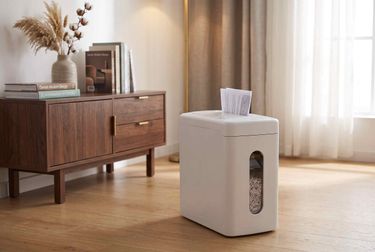
- Space and Aesthetics: Industrial models are enormous, often the size of a small refrigerator or filing cabinet, and they look exactly like utilitarian office appliances. Personal models feature compact designs that easily tuck under a desk, fit perfectly in a closet, or blend seamlessly into your curated home office decor.
- Acoustic Control: Heavy-duty machines prioritize raw power over noise reduction, often creating a loud, grinding mechanical roar that can disrupt your entire household. High-quality personal units are engineered with ultra-quiet operation, allowing you to destroy documents during a conference call, late at night, or without waking up a sleeping baby in the next room.
- Advanced Anti-Jam Technology: Because individuals do not have an IT department to fix broken equipment, modern personal units are highly optimized for a frustration-free experience. They feature responsive anti-jam sensors that automatically reverse the blades if you accidentally feed too much paper, saving you from spending an hour pulling out torn strips with tweezers.
- Cost-Effectiveness: Industrial machines can easily cost thousands of dollars. Personal models provide the exact same P-4 or P-5 security levels for a fraction of the cost. This leaves plenty of room in your budget for essential maintenance accessories that keep the blades running smoothly for years without the mess of bottled oil.
Ultimately, while massive machines have their place in corporate mailrooms, they bring unnecessary bulk, noise, and expense to a residential environment. A high-quality, well-maintained personal unit offers the perfect blend of security, convenience, and quiet operation for everyday consumers.
Conclusion
Understanding the core engineering and functional differences between shredding machines makes it clear why bigger is not always better. For corporate environments managing endless volumes of paperwork, commercial models are an undeniable necessity. But for protecting your personal privacy, managing household paper clutter, and securely destroying sensitive financial documents, a dedicated residential unit is simply the smarter, more efficient choice.
At Wingwise, we specialize in high-quality personal and home office equipment designed specifically for your unique space. With our ultra-quiet operation, advanced anti-jam technology, and maximum privacy through our cross-cut and micro-cut options, you can protect your identity without disrupting your household. Stop letting those old documents pile up in the corner of your room. Upgrade your workspace today by shopping for a reliable home shredder at Wingwise, and do not forget to pick up a pack of our premium lubricant sheets to keep your new machine running at peak performance for years to come.
FAQ
How long can a home shredder run continuously?
Most units designed for personal use can run continuously for anywhere from 5 to 30 minutes, depending on the specific motor and how heavily it is being used. Once the motor reaches its thermal limit, an automatic safety switch will turn the machine off to allow it to cool down, which typically takes about 30 to 45 minutes before you can resume.
Do I really need a micro-cut shredder for personal documents?
While cross-cut (P-4) is sufficient for everyday junk mail, upgrading to a micro-cut shredder (P-5) is highly recommended for sensitive personal data. It turns documents into thousands of unreadable particles, offering the highest level of protection against identity theft for your tax returns, bank statements, and medical records.
Why do commercial paper shredders cost so much more?
The high cost is due to the industrial-grade components required for continuous, all-day operation. They utilize heavy-duty metal gears, massive continuous-duty motors, advanced cooling systems, and large-capacity waste bins designed to withstand constant, daily abuse from dozens of users in a fast-paced corporate environment.
How often should I lubricate my shredder?
You should lubricate your blades every time you empty the waste bin, or at least twice a month if you use the machine frequently. Using convenient Wingwise shredder lubricant sheets is the easiest and mess-free way to maintain your equipment, ensuring the blades stay sharp, the motor runs quietly, and frustrating paper jams are prevented.
Will commercial shredders jam less than home versions?
Not necessarily. While commercial shredders have incredibly powerful motors, they will still jam if users exceed the maximum sheet capacity or feed sticky materials like adhesive labels. High-quality personal units are actually equipped with highly sensitive, advanced anti-jam technology that automatically stops and reverses the blades before a severe jam can occur, making them incredibly user-friendly for the average consumer.

©2025 shopastro All Rights Reserved.