
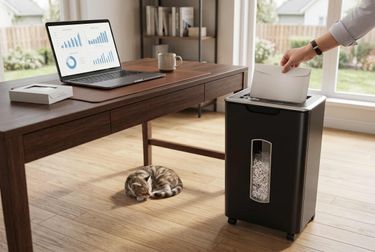
Do You Need a Heavy-Duty Paper Shredder for Your Home Office?
You are standing over a daunting, months-old pile of mail, sensitive credit card offers, and outdated tax documents that need to disappear. You switch on your current budget machine, and within two minutes, the motor begins to whine, the paper slows to a crawl, and the room fills with the dreaded smell of hot plastic. It is a highly common and deeply annoying frustration for anyone working from home. Naturally, your first instinct is to start searching the internet for heavy duty paper shredders to replace your struggling device. It feels like the most logical answer: buy the biggest, strongest machine you can afford, and the jamming problem will go away forever.
However, before you add a massive, commercial-grade beast to your virtual shopping cart, it is crucial to understand what you are actually buying. Homeowners and remote workers are frequently lured by the promise of high-volume capacity without fully realizing the associated trade-offs in physical size, ambient noise, and power consumption. While the marketing for industrial equipment is undeniably compelling, the reality of operating one in a home office or living room is usually quite different. Let us dive into what you truly need to effectively protect your personal privacy, eliminate paper jams, and keep your workspace running smoothly without turning it into a mailroom.
What Defines a Heavy-Duty Shredder?
When the office equipment industry talks about heavy duty shredders, they are explicitly referring to machines engineered for continuous, multi-user operation. In a bustling corporate setting where twenty or more people are destroying documents throughout the day, a machine simply cannot afford to stop every five minutes to trigger a thermal cooldown. These industrial devices are constructed with massive, solid-steel gear assemblies, heavy-duty induction motors, and robust internal cooling fans capable of running for an hour or more without a single interruption.
At their mechanical core, these devices are evaluated by a few distinct metrics rather than just their physical footprint. The first is the duty cycle, which dictates exactly how long the motor can operate continuously under load before the internal sensors force a shutdown to prevent a fire. The second is raw sheet capacity, meaning the machine's sheer physical ability to chew through 30, 40, or even 50 sheets of standard paper in a single pass. Finally, they are defined by their bin volume and throat width, often featuring floor-standing cabinets that hold thousands of shredded documents and slots wide enough to accept large-format legal or architectural paper without requiring the user to fold anything.
For a home office, however, "heavy-duty" is an entirely relative term. You might define it simply as a reliable machine that can handle an entire archive box of old utility bills in one sitting without jamming or overheating. It is vital to separate actual commercial requirements from the desires of a high-functioning remote worker. If you are not literally shredding reams of paper every single day, investing in an industrial-sized unit often results in unnecessary spatial bulk and higher baseline energy usage, which is ultimately overkill for your actual workflow.
Pros and Cons of Heavy-Duty Models at Home
Deciding whether to scale up your equipment requires an honest, objective look at your daily habits and your physical environment. If your shredding tasks are limited to a weekly purge of junk mail, a massive machine will simply become an expensive, noisy paperweight that takes up valuable legroom. Conversely, if you run a demanding home business, the sheer efficiency gains might easily justify the loss of floor space.
| Feature | Commercial Heavy-Duty Models | Premium Home Models (e.g., Wingwise) |
|---|---|---|
| Footprint & Design | Large, bulky, floor-standing, utilitarian | Compact, desk-side, aesthetically pleasing |
| Acoustic Profile | Loud, aggressive industrial motor noise | Ultra-quiet, sound-dampened technology |
| Document Capacity | High-volume continuous, 30+ sheets | Efficient for 12-15 sheet bursts |
| Maintenance Needs | Frequent, requires liquid oiling | Minimal, uses simple lubricant sheets |
| Security Level | Variable (often wider P-3 cross-cut) | Advanced P-4 or P-5 micro-cut options |
The primary advantage for users who generate a massive amount of physical paper—such as remote legal professionals, accountants, or those managing the intricate records of a small logistics business—is unapologetic speed. The ability to load a thick stack of stapled documents and walk away is a significant time-saver. Heavy duty office shredders are engineered specifically to power through heavy-gauge staples, thick paperclips, and even cardboard without hesitation, providing a sense of sheer convenience.
The drawbacks, unfortunately, are often ignored until the machine arrives at your front door. The most glaring issue is the acoustic disruption. Most heavy-duty units are significantly louder than modern home-office equipment, making them incredibly disruptive in a shared family space or during a Zoom call. Furthermore, the higher heat output requires active cooling vents, which translates to a larger, less attractive design that rarely matches home decor. Many home users are also surprised to learn that while the intake capacity is high, the actual security level—often a standard, wider cross-cut—is technically less effective at protecting sensitive data than the specialized micro-cut options found on smaller, modern home models.
When to Upgrade to a Heavy-Duty Shredder
So, how do you determine if you have genuinely outgrown your current setup and need a more capable device? You do not necessarily need a commercial-grade machine, but you absolutely might need a premium mid-range device that bridges the gap between casual and professional use.
Consider an immediate upgrade if you find yourself nodding along to the following scenarios on a regular basis:
- You are processing more than 500 sheets a week: If your weekend routine consistently involves an hour or more of feeding paper to clear out client files, your current machine is likely being pushed far beyond its intended thermal limit, which drastically shortens its lifespan.
- Your jam frequency has severely spiked: If you are spending more time aggressively yanking paper out of the feed slot or using tweezers to clear the cutting teeth than you are actually shredding, your motor lacks the necessary torque.
- You handle highly sensitive physical assets: If you are frequently shredding thicker cardstock, laminated identification documents, expired credit cards, or highly confidential financial information, you need a motor designed for heavier torque and a blade set designed for micro-cutting, not just raw volume.
If your daily life falls into these specific categories, seeking out a robust home solution is a highly intelligent move. However, you still do not need to leap straight to industrial hardware. Many modern home-office devices now offer localized, heavy-duty features—such as enhanced anti-jam sensors, hardened steel cutters, and extended 20-minute continuous run times—that provide the muscle of commercial units with the quiet operation and compact footprint specifically required for a domestic environment.
The Critical Role of Ongoing Maintenance
Regardless of whether you choose a towering high-capacity model or a sleek, compact micro-shredder to place under your desk, one inescapable truth remains: diligent maintenance is the ultimate key to machine longevity. A shredding device is only as good as the condition of its cutting cylinders. Over weeks and months of use, microscopic paper dust builds up tightly within the metal cutters, and the blades gradually lose their factory-applied, friction-reducing coating.
Neglecting this basic maintenance is the absolute fastest way to destroy a shredder motor. As friction increases, the machine has to work much harder to pull paper through, which generates excessive internal heat. Eventually, the plastic internal gears will literally warp or snap under the immense pressure.
This is where incredibly simple maintenance habits save you from a costly replacement. Utilizing specially designed lubricant sheets every single time you empty the waste bin is the single most effective way to protect your investment. These clean, no-mess sheets evenly distribute a perfectly calibrated dose of high-quality oil directly across the cutting cylinders. This instantly reduces metal-on-metal friction, permanently prevents paper jams, and ensures the motor runs quietly for years to come. Whether you have an over-engineered metal shredder or a highly efficient home-friendly model, keep a pack of these lubricant sheets in your desk drawer; they are the true, unsung heroes of personal information security.
Finding the Perfect Balance with Wingwise
At Wingwise, we fundamentally understand that your home office is a personal sanctuary, not an industrial warehouse. You require a device that is inherently reliable enough to handle your heavy-duty purging tasks, yet quiet enough that you can still hold a conversation or take a conference call while it is actively running in the background.
Our entire product line is meticulously designed to strike this exact balance. We focus heavily on high-security micro-cut technology that aggressively turns your tax returns, bank statements, and shipping labels into completely unreadable particles, ensuring your identity and personal data remain absolutely safe from theft. By integrating our proprietary anti-jam technology, we have permanently eliminated the frustration of the sudden motor whine and stoppage, allowing you to work with total confidence and speed. We provide the undeniable power and torque of an office-grade machine, packed cleanly into a sleek, modern design that fits perfectly under your desk or tucked neatly into a corner.
Do not settle for a noisy, oversized piece of machinery that creates more visual clutter than the paper it was meant to destroy. Explore our curated collection of highly efficient home shredders and essential maintenance kits today, and find the perfect, reliable partner for your daily privacy needs. Let Wingwise help you keep your workspace impeccably clean, highly secure, and peacefully productive.
FAQ: Shredding Solutions for Your Home
What is the primary difference between a micro-cut and standard cross-cut machine?
A micro-cut machine, typically classified under P-4 or P-5 security standards, utilizes tightly intersecting blades to turn paper into tiny, confetti-like particles, making it virtually impossible for identity thieves to reassemble. A standard cross-cut machine leaves much larger, longer strips. For any sensitive financial or personal data, micro-cut technology is highly recommended.
How loud are heavy duty office shredders compared to home models?
Commercial-grade heavy duty office shredders are engineered for high-traffic, industrial environments where ambient noise is already high, meaning they can be exceptionally loud. Conversely, premium home models, like those from Wingwise, utilize advanced acoustic engineering and sound-dampening enclosures to ensure ultra-quiet operation, protecting your home's peaceful environment.
How often should I use maintenance lubricant sheets?
As a general rule, you should run one lubricant sheet through the machine every single time you empty the waste bin, or at least once a month for moderate, casual use. This essential maintenance dramatically reduces blade friction, keeps the cutting teeth sharp, and is the best way to prevent motor-destroying paper jams.
Can premium home shredders handle things like credit cards and thick staples?
Yes. Most modern, high-quality home-office machines—including the Wingwise lineup—are built with hardened steel cutters designed specifically to bite through standard office staples and paperclips without any hesitation. Many also feature dedicated slots or specific torque ratings to safely destroy expired plastic credit cards.
Is "duty cycle" the most important specification to look for when buying?
While the duty cycle (continuous run time) is highly important for commercial settings, it depends entirely on your specific home workflow. If you prefer to shred documents in short, frequent bursts, investing in advanced anti-jam technology and a higher security rating (micro-cut) is often far more critical than worrying about a 60-minute continuous run time.

©2025 shopastro All Rights Reserved.