
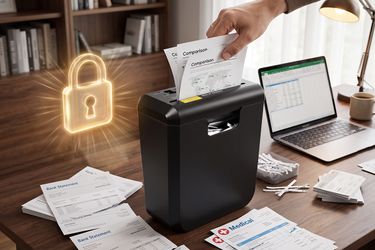
How to Securely Dispose of Bank Statements and Medical Bills at Home
That stack of old bank statements, medical bills, insurance papers, and credit card offers sitting in a drawer may not look like a big deal. But once those documents contain your name, address, account details, or medical information, simply tossing them into the trash can leave more personal data exposed than you might expect.
A reliable best home document shredder can turn sensitive paperwork into small, difficult-to-reconstruct pieces before it leaves your home. But how secure does your shredder really need to be, and when is a micro-cut model worth the upgrade?
The Hidden Dangers in Your Daily Mail
Most people think of identity theft as something that happens online. Yet physical documents can still reveal plenty of information about you. A discarded bank statement may include your name, address, account information, transaction history, or other details that could be combined with information from other sources.
The same applies to everyday mail. You may want to get rid of:
- Bank statements and credit card statements
- Utility and phone bills
- Insurance documents
- Pre-approved credit card offers
- Shipping labels with your home address
- Expired checks and financial paperwork
- Documents containing Social Security or account information
Simply tearing a document in half usually isn't enough. Even if individual pieces look unreadable, larger fragments can potentially be collected and examined.
This is where secure document shredders become useful. Instead of leaving readable information in your trash, a cross-cut or micro-cut machine breaks paper into much smaller pieces. Different security levels allow you to choose between everyday document protection and more advanced shredding for highly sensitive information. For most households, the right choice comes down to the types of documents you handle and how frequently you need to shred them.
For routine household paperwork, a P-4 cross-cut shredder can provide a practical balance between security, capacity, and speed. If you regularly handle highly sensitive financial records, however, stepping up to P-5 micro-cut technology provides an additional layer of protection.
There's also a simple habit worth adopting: don't wait until you have a huge pile of documents. Shred sensitive paperwork as you finish with it. A few minutes of regular shredding is much easier than dealing with an overflowing box of old paperwork later.
Personal Medical Records: Why Shredding Matters
Medical documents are easy to overlook when you're cleaning out a filing cabinet. After all, a medical bill may look like an ordinary piece of paper. But healthcare paperwork can contain your name, address, provider information, insurance details, account numbers, treatment information, and other personal data.
That makes medical records particularly important to dispose of carefully.
If you're clearing out old paperwork at home, consider shredding documents such as:
- Medical bills and payment statements
- Explanation of Benefits (EOB) documents
- Prescription-related paperwork
- Insurance statements
- Appointment records containing personal information
- Old healthcare correspondence
A secure document shredder is especially useful when several types of sensitive paperwork accumulate together. Rather than manually tearing each document into tiny pieces, you can feed the papers directly into a cross-cut or micro-cut shredder.
For highly sensitive medical and financial documents, micro-cut shredding is an attractive option because it produces substantially smaller particles than conventional strip-cut shredding.
P-5 micro-cut shredders are designed for documents containing highly sensitive information and produce much smaller particles than standard cross-cut models. A 2 × 12 mm cut size, for example, turns a sheet of paper into significantly smaller pieces, making the original document much harder to reconstruct.
The right choice also depends on how you use the machine. A household that shreds a few bills each week doesn't necessarily need an oversized commercial machine. Compact dimensions, quiet operation, an appropriate sheet capacity, and anti-jam protection may be more valuable for everyday home use.
In other words, the goal isn't to buy the most powerful shredder available. It's to choose a machine that makes secure disposal easy enough that you'll actually use it.
Choosing the Right Security Level for Financial Data
Not every document requires the same level of protection. A piece of junk mail containing your name is different from a bank statement containing financial information.
That's why paper shredders are often categorized by security levels and cutting methods. For home users, the most relevant comparison is usually between P-4 cross-cut and P-5 micro-cut shredding.
| Security Level | Cutting Type | Suitable Documents | Best For |
| P-2 | Strip-Cut | Non-sensitive papers, drafts | Basic disposal |
| P-4 | Cross-Cut | Bills, bank statements, personal records | Everyday household privacy |
| P-5 | Micro-Cut | Tax, medical, financial, legal documents | Highly sensitive information |
| P-7 | High-Security Micro-Cut | Specialized confidential information | Government/enterprise applications |
P-4 is generally a practical choice for household bills, bank statements, and everyday personal records, while P-5 provides a higher level of protection for sensitive financial, medical, legal, and confidential business documents.
Cross-Cut vs. Micro-Cut
Cross-cut shredders slice paper into short pieces rather than long strips. This makes them a strong everyday option for households that regularly dispose of bills, statements, and general personal documents.
Micro-cut shredders go further by producing much smaller particles. That extra level of destruction is useful when you're dealing with documents that contain particularly sensitive information.
How Much Capacity Do You Really Need?
Sheet capacity matters, but bigger isn't automatically better.
For occasional household shredding, a 10- or 12-sheet machine can handle a typical stack of documents without requiring a large commercial footprint. If you routinely shred years of financial records or operate a home business, a larger bin and longer runtime may save considerable time.
Home shredders range from compact models designed for occasional use to heavy-duty machines built for large volumes of paperwork. If you only shred a few bills and statements each week, a 10- to 12-sheet model with a moderate-size bin may be more practical. For households that regularly process years of financial records or handle business paperwork, a larger bin and longer runtime can reduce interruptions.
Best Home Document Shredders for Ultimate Privacy
The best home document shredder isn't necessarily the model with the highest security rating or largest motor. For most consumers, the better question is: What kind of documents do I actually shred, and how often?
If your typical workload consists of bank statements, bills, expired cards, and personal mail, a P-4 cross-cut model can provide strong everyday protection without taking up excessive space.
If your household regularly handles medical records, tax documents, financial paperwork, or confidential work materials, a P-5 micro-cut shredder is a more privacy-focused choice.
When comparing secure document shredders for home use, pay attention to more than just the security level:
- Noise level: A quieter motor is much more comfortable in a bedroom, study, or home office.
- Anti-jam technology: Automatic reverse or overload detection can make shredding considerably less frustrating.
- Runtime: Choose enough continuous operating time for your typical workload rather than paying for unnecessary commercial capacity.
- Bin size: A larger pull-out bin means fewer interruptions when you're clearing a large batch of paperwork.
- Maintenance: Regular lubrication helps keep cutting components operating smoothly and can reduce paper dust and friction.
- Footprint: A compact machine is easier to keep accessible, which matters because a shredder that is buried in a closet is less likely to be used.
Maintenance is easy to overlook. Paper dust gradually accumulates around the cutting mechanism, and friction can affect performance over time. Wingwise offers dedicated lubricant sheets designed to help maintain cutting performance and reduce the risk of jams.
For a typical home, the ideal setup is often surprisingly simple: keep the shredder somewhere convenient, use it regularly instead of letting sensitive paperwork pile up, and maintain it according to the manufacturer's recommendations.
Most importantly, don't choose a machine based solely on the phrase "high security." Match the security level to the information you're protecting. P-4 is often enough for everyday household documents, while P-5 micro-cut provides greater protection for highly sensitive financial and medical records. P-7 models exist for specialized high-security applications, but they're generally unnecessary for ordinary home use.
The result is a much safer disposal routine without turning document management into a chore.
Conclusion
Your bank statements and medical bills don't belong in the trash with your everyday waste. A reliable shredder makes it easy to turn sensitive paperwork into tiny, difficult-to-reconstruct pieces before disposal.
Whether you need a compact cross-cut shredder for everyday bills or a P-5 micro-cut model for highly sensitive records, choosing the right security level can make document disposal much safer and easier. Explore Wingwise's paper shredders and lubricant sheets to build a simple, reliable document security routine for your home.
Frequently Asked Questions
What is the best home document shredder for bank statements?
A P-4 cross-cut shredder is suitable for most household bank statements. If you want higher privacy protection, a P-5 micro-cut model is an excellent upgrade.
Is a micro-cut shredder better for medical bills?
Yes. A micro-cut shredder creates smaller paper particles and provides a higher level of document security, making it well suited to medical bills, insurance records, and other sensitive paperwork.
What security level should I use for financial documents?
For everyday financial documents, P-4 cross-cut is generally a practical choice. For tax records and highly sensitive financial information, P-5 micro-cut offers stronger protection.
How many sheets should a home paper shredder handle?
A 10- to 12-sheet paper shredder is sufficient for many homes and home offices. Larger capacities are more useful when you regularly shred large batches of documents.
How do I prevent paper jams in a shredder?
Avoid exceeding the sheet capacity, remove clips or materials not supported by the machine, and maintain the cutting mechanism regularly. Lubricant sheets can also help keep the blades operating smoothly.
Are secure document shredders noisy?
They can be, but many modern models are designed for quieter operation. For example, Wingwise's S4310 operates at up to 48 dB, making it suitable for home offices and shared spaces.
How often should I maintain my paper shredder?
For regular home use, periodic lubrication helps maintain smooth cutting performance. If you shred frequently, follow the manufacturer's maintenance recommendations and consider using lubricant sheets as part of your routine.

©2025 shopastro All Rights Reserved.